Most network graphs in fraud detection lose accuracy as device identifiers change. Incognia's doesn't.
The difference comes down to the identity layer beneath the visualization. Incognia’s Network Graph is built on a sticky, tamper-resistant device ID that can consistently re-identify the same device across app reinstalls, factory resets, and app tampering.
Because the device identity persists, relationships in the graph remain stable over time. This means you can trust the connections you’re seeing, investigate faster, and stop repeat and large-scale fraud with more confidence.
The problem with most network graphs
Over time, limitations in many other fraud vendor network graphs start to show.
A fraudster operates from a single device, using common evasion tactics like app reinstalls, device resets, or tampering. For many network graphs, each of those changes appears as a new device.
So for example, one device might appear as 10 separate devices in the graph.
But with Incognia, that activity is recognized as coming from one device exhibiting the same behavior over time. Instead of fragmenting into multiple nodes, the behavior stays connected.
This shifts the investigation from chasing multiple devices to understanding that it’s just one persistent actor.
Why most network graphs degrade over time
Many other fraud vendor network graphs rely on identifiers that are easy to change, like IP addresses, cookies, or unstable device intelligence. Some changes are normal user behavior. Others are the result of intentional evasion. In both cases, the identity behind the activity no longer stays consistent.
As those identifiers change or disappear, the graph stops being continuous. It captures activity accurately at a moment in time, but gradually loses fidelity as the underlying signals shift. Relationships that once looked clear become incomplete or missing.
You still see nodes and edges, but the connections represent stale or incomplete data. Investigations start to focus on artifacts of identifier changes instead of real behavior. False positives increase, analysts spend more time sorting through noise, and repeat fraud becomes harder to recognize.
The other limitation is that many graphs treat connection as evidence of fraud, failing to recognize that legitimate users share environments, too. Families share devices. Roommates use the same Wi-Fi. Colleagues connect from the same office networks.
A useful graph does more than show connections. It helps distinguish which relationships persist over time, which ones repeat in meaningful ways, and which ones should actually influence a decision.
Persistent device identity changes everything
Building a network graph visualization is straightforward. Drawing nodes and edges isn’t the hard part.
The hard part is the underlying data layer. If the identity layer is weak, the graph produces false positives. But if the identity layer is persistent, the graph reveals real, long-term fraud relationships.
That's the difference with Incognia's Network Graph. We built it on a sticky, tamper-resistant device ID that holds up as fraudsters change and adapt their tactics.
The same device can still be re-identified even after app reinstalls, factory resets, or app tampering.
Because of that persistence, the connections in the graph remain reliable. When you see a connection, you can trust it. When you see a cluster, you can act on it. When you write a policy based on what you're seeing, you know it will hold up over time.
This is also why the graph becomes stronger and more accurate as more activity accumulates.
Instead of analyzing ten potentially unrelated signals, you can easily identify that it’s one actor with a consistent pattern of behavior.
Faster and more focused investigations
The network graph fundamentally changes how you see fraud. Instead of evaluating individual events in isolation, it allows teams to understand connected behavior as it develops over time.
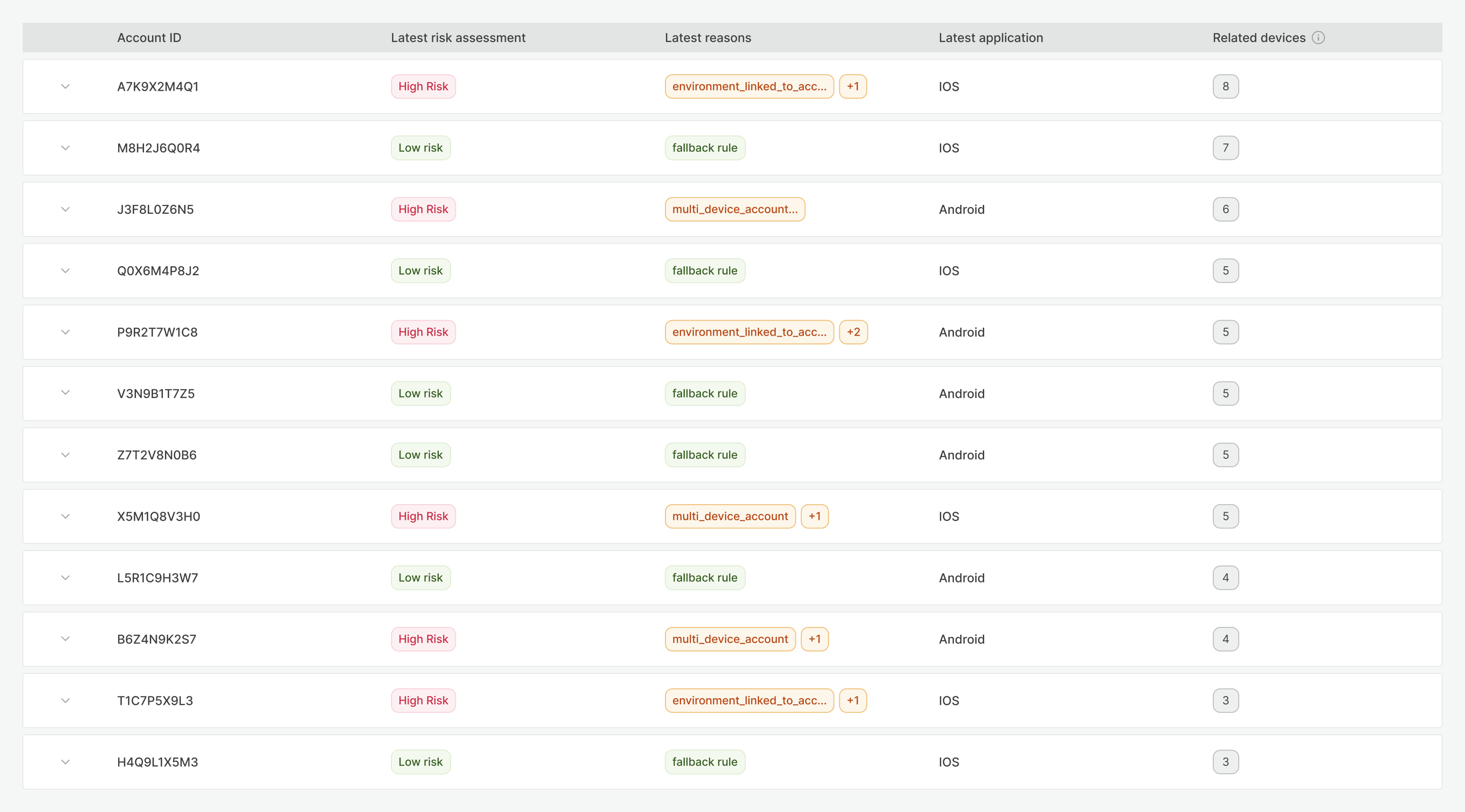
All of the underlying data may already exist in tables. Device identifiers, account associations, timestamps. The limitation is how that data is consumed. Tables encourage transaction-by-transaction review.
Each event is evaluated on its own, which makes it difficult to recognize broader patterns, especially those associated with coordinated or organized fraud:
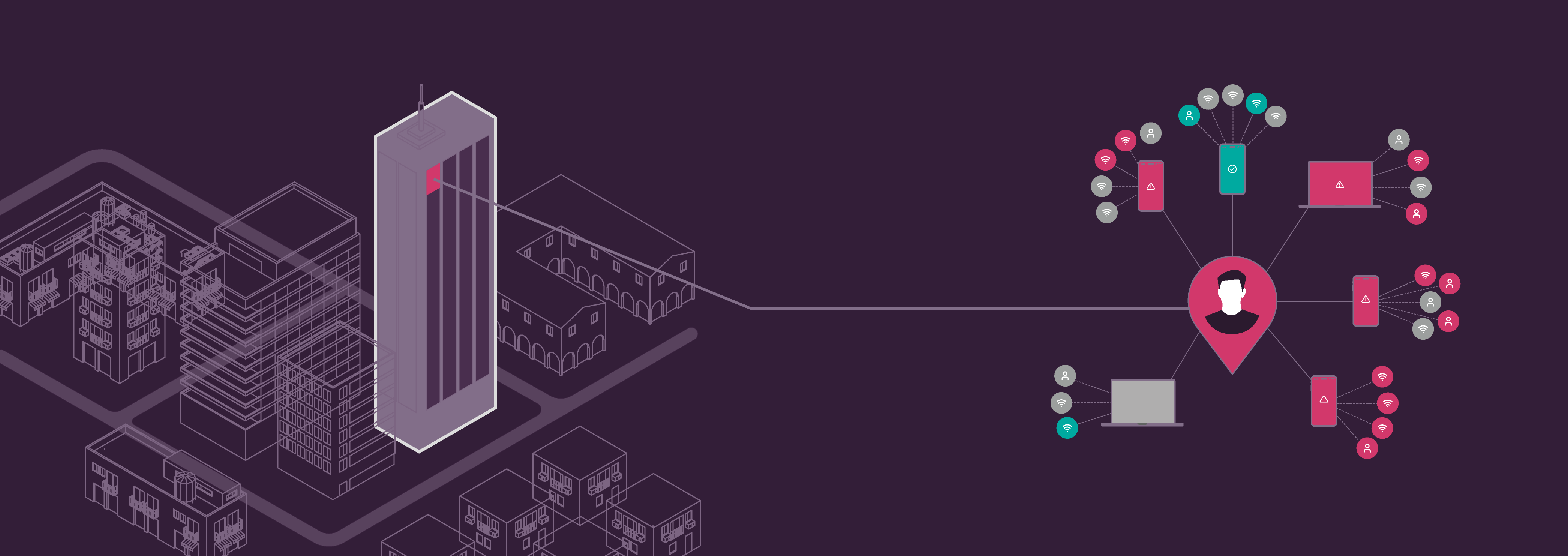
A network graph surfaces those patterns directly. When a cluster of accounts is connected to a single device, the structure of the activity becomes immediately clear:
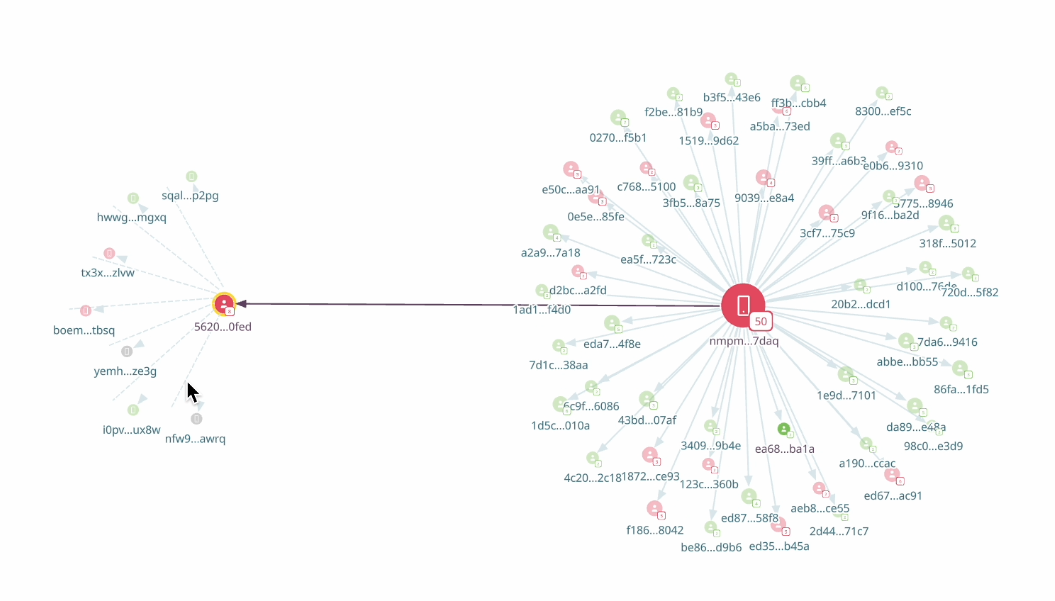
You can see the scope of the behavior, how it evolves, and how risk concentrates across accounts, all in one view.
This is why relationships are hard to reason about in tables but easier to visualize in a graph.
When the identity layer underneath the graph is persistent, the impact on investigations is immediate.
Analysts don’t need to manually reconstruct context across multiple views. The connections are already visible.
Before this view existed, customers often asked questions like how many accounts a device accessed, when that activity occurred, and which connections were high risk. Those answers required additional investigation and back-and-forth. With the Network Graph, that context is available directly, allowing teams to move from pattern recognition to action much more quickly.
That speed matters in practice. When teams are triaging dozens or hundreds of potential signals, faster understanding leads to better prioritization. The sooner the shape of the behavior is clear, the easier it is to decide what requires immediate attention, what can wait, and what is likely low risk.
Your starting point for investigation
I think about the Network Graph as the starting point for investigation. It's where analysis starts with context instead of assumptions.
The graph provides an immediate view of how devices, accounts, and other entities relate to one another, along with the associated risk signals. From that view, you can decide where to go deeper, whether that’s device details, account history, or specific transaction activity.
What makes this starting point effective is that it removes the need to reconstruct context manually. Instead of piecing together fragments across multiple screens, teams can see the full structure of the behavior first and then choose where to focus their time.
Turning patterns into policies
Incognia’s Network Graph helps you see the patterns and act on them.
Suspicious Wi-Fi nodes are a good example. When device identity persists, shared infrastructure becomes easier to recognize. The same networks appear repeatedly across devices and accounts, making it possible to distinguish isolated activity from coordinated behavior.
Once that pattern is visible, you can identify clusters operating from the same network and determine which Wi-Fi environments are consistently associated with fraud.
That insight can then be applied directly in policy.
If a specific network has been confirmed as part of fraud infrastructure, you can define a rule that treats any device connecting from that Wi-Fi as high risk. The logic is straightforward and consistent, and it does not depend on additional context to be effective.
This approach is also more precise than broad location-based restrictions. Instead of limiting access across an entire area, enforcement is applied at the network level. That precision helps stop repeat fraud while reducing unnecessary impact on legitimate users nearby.
This is where the Network Graph becomes operational. It connects durable patterns to automated decisions, with confidence that the underlying relationships are stable and meaningful.
A real example: Uncovering a coordinated fraud farm
In one recent investigation, a customer noticed a cluster of high-risk activity coming from the same geographic area. Dozens of devices and accounts were repeatedly flagged in close proximity, a pattern often associated with fraud farms.
Using Incognia’s Network Graph, the team moved beyond individual risk scores and analyzed relationships between entities.
One device quickly stood out. Over a short period of time, it accessed hundreds of accounts, maintained multiple active app installations, and attempted dozens of new account creations. The volume and consistency of this behavior pointed to systematic abuse rather than isolated fraud.
Expanding the graph made the broader structure visible:
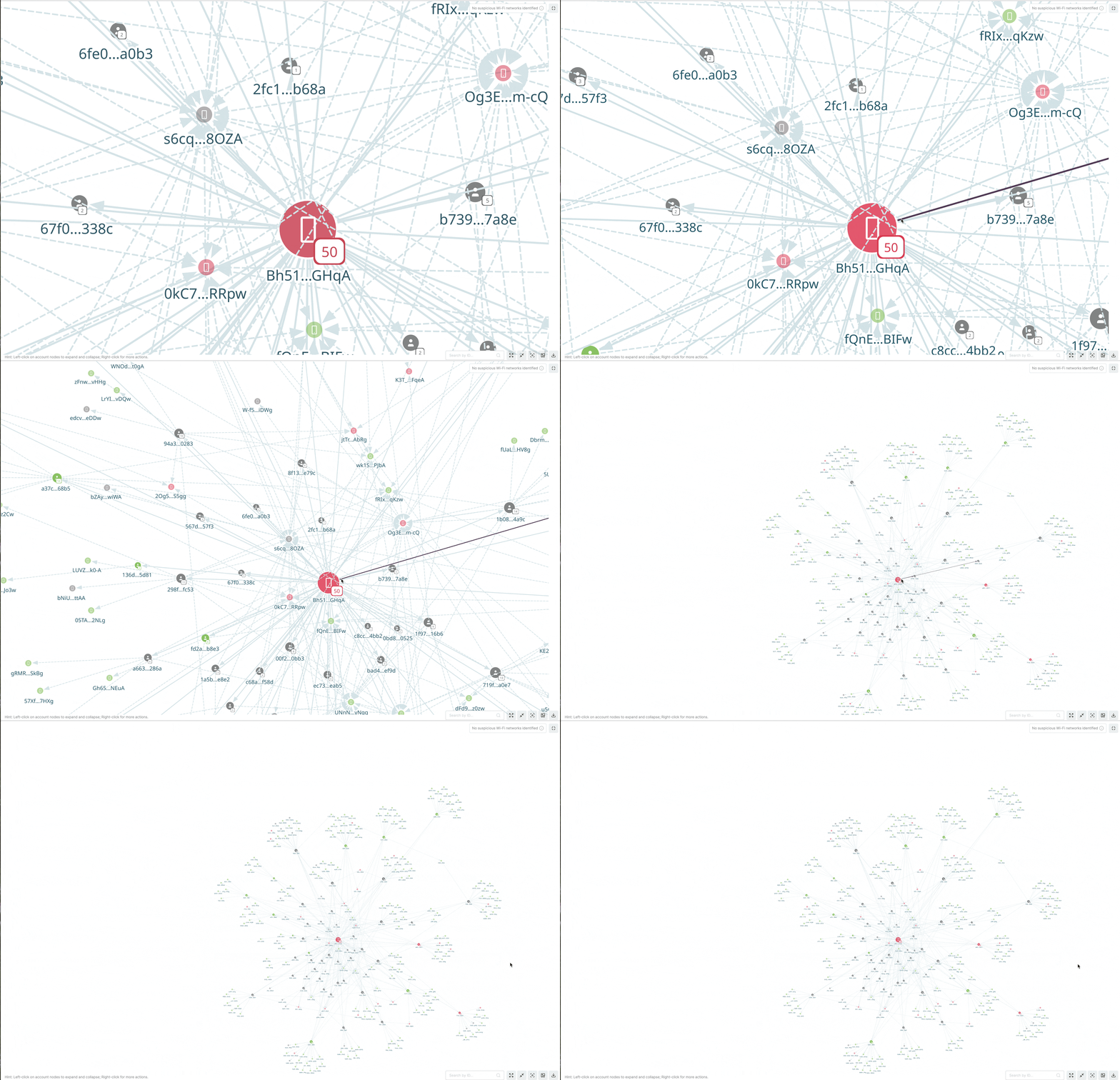
The same device was connected to a tightly linked set of accounts and devices distributed across multiple regions. While this activity appeared fragmented in tabular views, the network view revealed a coordinated operation.
Because the device identity persisted and the relationships held up over time, the customer could see the structure behind the fraud and take action.
After reporting the fraudulent devices, this customer saw a significant reduction in fraud during the onboarding process.
Trust what’s in your Network Graph with Incognia
When you rely on a network graph for fraud detection, you’re relying on it to remain accurate as fraudsters change tactics. That is the real test of its usefulness.
Most graphs get noisier over time as identities fragment and connections multiply. Incognia's gets clearer.
Fraud patterns accumulate instead of disappearing, actor behavior sharpens instead of scattering, and decisions are based on stable relationships rather than transient signals.
That reliability comes from persistent device identity. It allows the graph to remain trustworthy not just in the moment, but over weeks and months of evolving fraud behavior.
We built Incognia's Network Graph to support faster investigations and more confident decisions at scale. We’ll continue to invest in the Network Graph itself, improving how patterns surface, how insights translate into action, and how the graph evolves as more fraud data accumulates over time.