Strengthening Web Risk Decisions with Behavioral Biometrics
Behavioral biometrics gives fraud teams another source of evidence for understanding how someone is interacting with a web session. By evaluating signals like mouse movement, keyboard activity, clicks, and clipboard behavior alongside the broader risk picture, businesses can make more informed decisions about which sessions can proceed and which need stronger verification. When web evidence still isn’t enough, trusted mobile and physical-world context can help resolve the uncertainty.
Subscribe to Incognia’s content
Fraud teams can assess a lot about a web session. But compared with a trusted mobile interaction, due to the browsers sandboxes the web naturally provides less direct evidence about the customer, the device they’re using, and the physical context behind the session.
That can make an important question harder to answer:
What signal can make this web session trustworthy?
The answer rarely comes from one signal.
The more relevant evidence you can bring into the decision, the clearer that decision can become.
Behavioral biometrics adds an extra layer of protection to the picture.
Behavior adds another view of the web session
Behavioral biometrics adds another source of evidence for web risk decisions by helping fraud teams understand how someone is interacting with a web session.
Traditional web risk signals can provide context about the environment around a session. Behavioral signals add a different view: evidence about what is happening within the interaction itself.
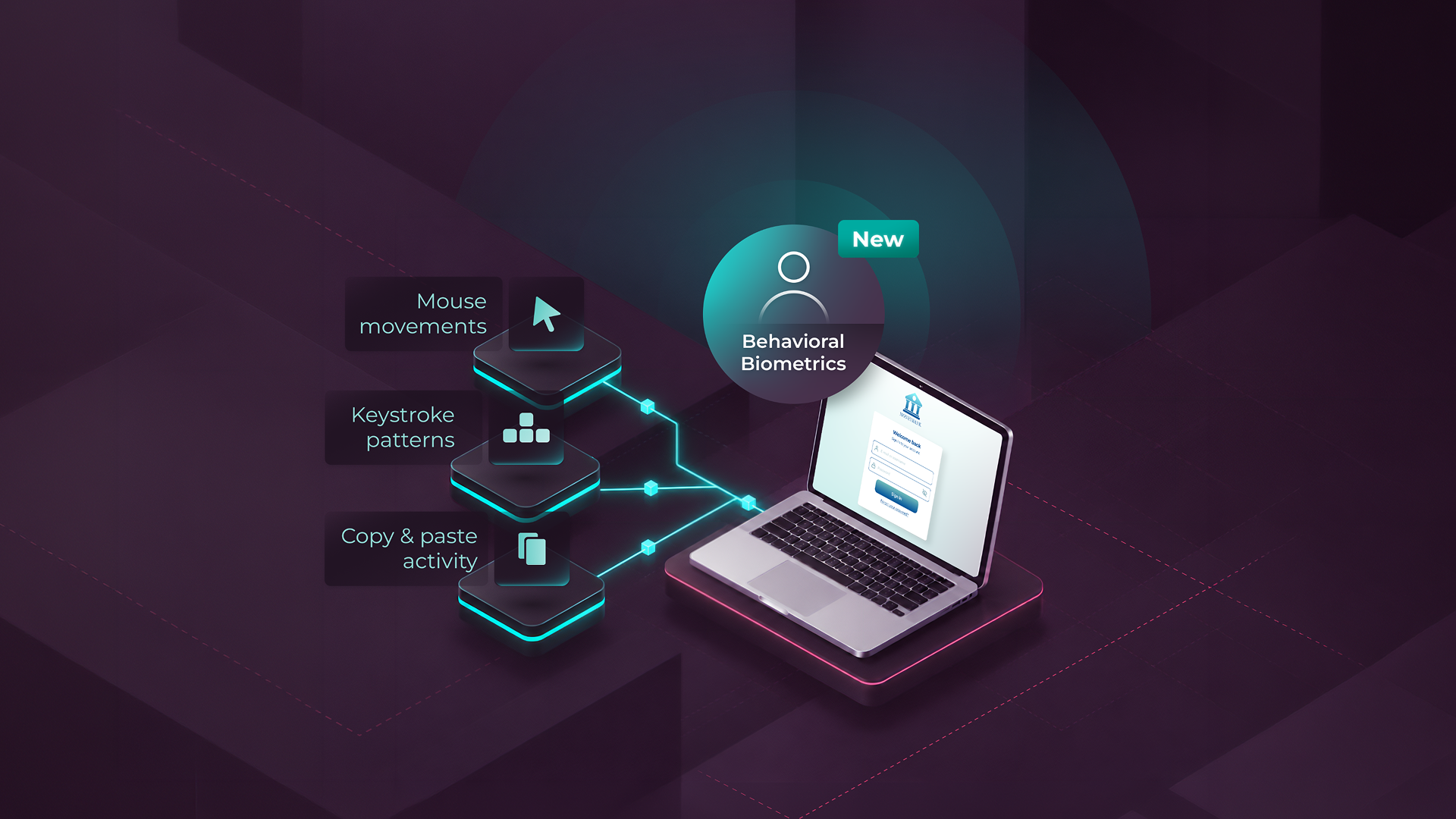
Mouse movements, keyboard activity, clicks, and clipboard behavior can reveal patterns such as unusual cursor movement, synthetically generated events, or unexpected copy-and-paste activity.
That evidence can help identify patterns that may be consistent with automation or other higher-risk activity.
But behavioral signals are not definitive on their own.
A legitimate customer might copy and paste information. Their mouse movements may be unusual. One unexpected interaction does not automatically mean fraud.
The value comes from using behavioral evidence as one part of the broader risk decision, rather than treating any individual behavior as proof of fraud.
Bringing behavioral biometrics into Incognia’s web risk intelligence
Incognia is expanding its web risk intelligence with behavioral biometrics, giving fraud teams another source of evidence for evaluating web sessions.
Incognia can now assess supported behavioral signals including:
-
Mouse movement and clicks, including unusual cursor movement, spatial “teleports,” and whether mouse or click events appear to be trusted browser events or synthetically generated
-
Keyboard interaction, including keyboard activity and signals that can identify artificially generated key-down or key-up events
-
Copy, paste, and cut activity, including clipboard behavior and whether those events appear trusted or artificially generated
Those signals aren’t evaluated in isolation.
They can be assessed alongside Incognia’s existing web risk intelligence, including browser intelligence, device intelligence, integrity and tamper signals, bot and automation detection, and Verified IP Location.
Each answers a different question about the same interaction.
Behavior can tell you more about how the session is being used.
Browser and device intelligence provide context about the environment behind it.
Integrity and automation signals can indicate whether that environment or interaction may be manipulated.
Location evidence adds another piece of context around where the session may be originating.
Taken together, those signals give the business more relevant evidence for deciding what should happen next.
Turn more evidence into a clearer decision
Collecting more risk signals only helps if they improve the decision you need to make.
For most web interactions, that decision ultimately comes down to two paths:
There is enough evidence to let the session proceed.
Or:
The session requires additional verification before the action can continue.
That distinction matters because the alternative is often a bad tradeoff.
If every uncertain interaction receives additional authentication, legitimate customers inherit more friction.
If the business lets every ambiguous session through, it takes on more risk.
Correctly using this extra data intelligence layer will help reduce uncertainty and have a smaller gray area, allowing more directed friction, with less risk.
But there will still be sessions where web evidence alone isn’t enough.
When the web isn’t enough, bring the trusted device into the decision
Imagine a customer is attempting a higher-risk account change from the web.
Behavioral signals and the broader web risk assessment help the business evaluate the session. But for a sensitive action like this, the business may determine that stronger verification is required before allowing it to proceed.
That doesn’t mean the session is fraudulent. It means the action warrants an additional verification step.
Instead, it can ask the customer to take an explicit verification step on their trusted mobile device through Incognia’s Cross Device Authentication.
That opens up a new set of evidence.
Incognia can assess the customer’s trusted device relationship and device integrity, whether the mobile device and web session are physically near each other, and whether the mobile location is trusted for that customer.
The web session has gone from an interaction with limited physical context to a decision that can incorporate evidence tied to a trusted device and the customer’s physical world.
The business still makes the final risk and authorization decision. But now it has more to base that decision on.
What this can look like in practice
Behavioral signals become most useful when they add context to a specific decision.
A login that looks normal enough to proceed
A customer logs into their account from the web and moves through the session normally.
Mouse and keyboard activity appear to come from trusted browser events, and there are no meaningful behavioral anomalies that increase concern.
Behavioral evidence alone does not “prove” the customer is legitimate, but it can contribute to the broader assessment that there is enough evidence for the session to proceed.
A session showing signs of synthetic interaction
Another customer begins entering information into a web form, but some mouse or keyboard events appear to be artificially generated rather than trusted browser events.
The session may also show unusual cursor movement or other behavioral anomalies.
None of those signals automatically means fraud.
But together, they can give the fraud team more reason to treat the session as higher risk and require stronger verification before allowing a sensitive action to continue.
A higher-risk account change that needs more confidence
A customer attempts a sensitive account change from the web. The available behavioral evidence does not provide enough confidence to let the action proceed without another check.
The business can ask the customer to complete an explicit verification step on their trusted mobile device through Cross Device Authentication.
Incognia can then bring additional evidence into the decision, including the trusted device relationship, whether the phone and web session are physically near each other, and whether the mobile location is trusted.
Better web risk decisions come from connecting the evidence
No single signal will answer every web risk decision.
That’s the point.
Behavioral biometrics gives fraud teams another view into what is happening inside a web interaction.
Together with browser, device, integrity, automation, and location intelligence it provides more context around it. And when those signals still don’t provide enough confidence, a trusted mobile device can bring additional customer, device, and physical-world evidence into the decision.
The result isn’t simply more data.
It’s a clearer way to decide when a web session has enough evidence to proceed and when it needs stronger verification.
That’s the role behavioral biometrics now plays within Incognia’s broader web risk intelligence.
Frequently asked questions
What is web behavioral biometrics?
Web behavioral biometrics uses interaction signals such as mouse movement, keyboard activity, clicks, and clipboard behavior to provide evidence about how someone is using a web session. These signals can help fraud teams better understand what is happening within an interaction and support broader web risk decisions.
What behavioral signals can be used to assess a web session?
Incognia can evaluate signals including mouse movement and clicks, keyboard interaction, and copy, paste, and cut activity. This can include patterns such as unusual cursor movement, synthetically generated mouse or keyboard events, and untrusted clipboard activity.
Can behavioral biometrics detect fraud on its own?
No single behavioral signal should be treated as proof of fraud. Legitimate users can behave in unexpected ways, so behavioral evidence is most useful when it contributes to a broader risk assessment.
How does behavioral biometrics improve web risk decisions?
Behavioral biometrics adds evidence about what is happening within the interaction itself. When combined with other available risk signals, it can help businesses decide which web sessions have enough evidence to proceed and which may require stronger verification.
What happens when web signals do not provide enough confidence?
When a session requires stronger verification, the customer can complete an explicit step-up on a trusted mobile device through Cross Device Authentication. Incognia can then bring additional evidence into the decision, including the trusted device relationship, physical proximity between the mobile device and web session, and whether the mobile location is trusted.