Product ExplainedScam Prevention

A customer gets a call from someone claiming to be their bank. The caller says their account is at risk and tells them to move their money to a “safe account.” The customer opens their banking app and approves the transfer.
From the sender’s side, everything can look legitimate. It’s the real customer, using their usual phone and authorizing the payment themselves. Those checks don’t reveal that the account receiving the money belongs to a scammer.
Looking at the relationship behind the payment gives the bank more to work with. Is there evidence that the customer and recipient know each other? What does the receiving account’s history show?
Incognia’s Physical Social Graph uses historical location patterns and persistent device intelligence to identify signals that may indicate real-world relationships between people. It’s a core part of our Real-Time Scam Prevention solution.
For banks, the graph adds evidence about a possible connection between the sender and recipient. They can assess that evidence alongside what they know about the receiving account and the customer’s device to better understand the payment’s risk.
How the Physical Social Graph works
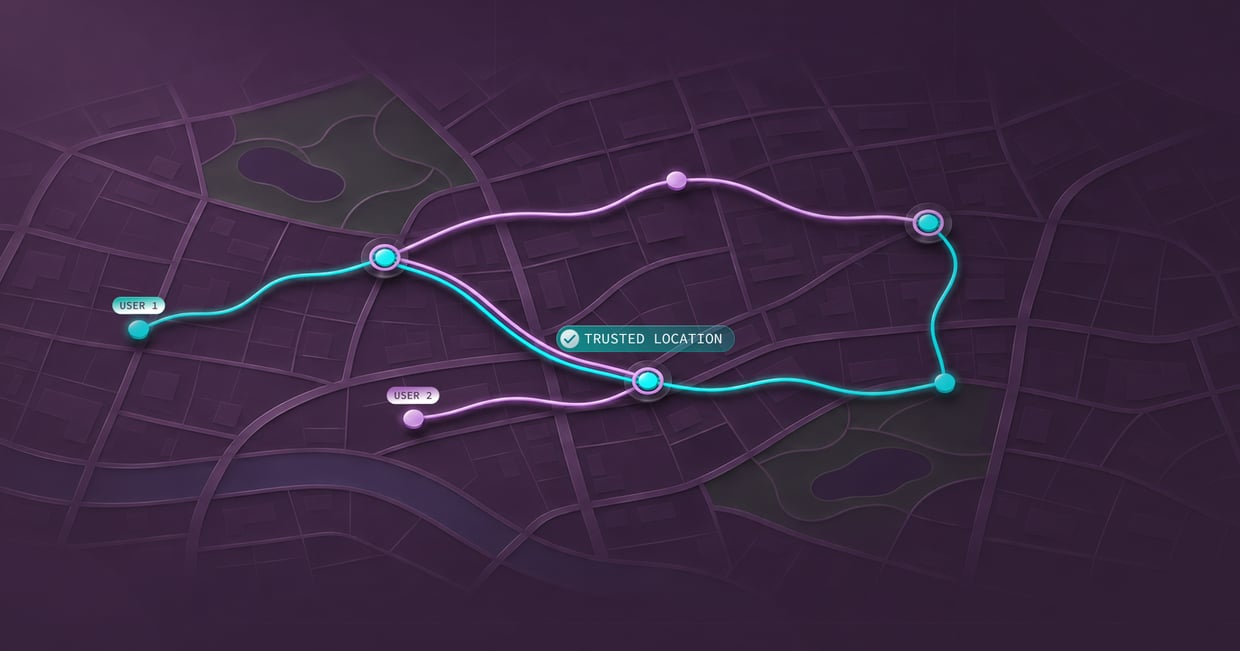
The graph starts with Incognia’s patented Trusted Locations technology. By looking at how often a device returns to a place and how much time it spends there, Incognia identifies places that are familiar to its user.
The Physical Social Graph then looks for recurring patterns in the sender’s and recipient’s histories. When their devices regularly visit some of the same places, that can be a strong sign of a physical-world relationship.
A customer might send money to a family member while traveling. The payment is happening somewhere new, but the two people may have a long history of visiting the same places. The graph can use those patterns to help the bank assess the payment.
But, people can make legitimate payments without an observed relationship, too. The graph’s finding becomes more useful when assessed alongside those other signals, helping the bank decide which payments need closer attention.
For example, a customer is sending money to a new recipient, and the available history shows no observed physical-world relationship between them. The customer is also on an active call, or there are signs that someone is controlling their phone remotely.
Another example. A customer is sending money to a new recipient whose account has been flagged as a potential mule account. Combined with the information that these two users don’t have a relationship in the physical world, the likelihood that the transaction is the result of a scam is higher.
Together, these signals give the bank stronger reasons to suspect a scam than any one signal would on its own.
Precision makes the relationship evidence useful
People can pass through the same train station every day without knowing each other. Even sharing an apartment building tells you little on its own. To assess a possible relationship, the graph needs a more precise picture of the places behind those visits.
IP or GPS data alone can't reliably provide that level of detail. IP geolocation can group unrelated people into the same city. GPS can be more precise, but its indoor limitations make it unreliable for distinguishing neighboring apartments or different floors.
Building a graph from broad observations risks connecting people simply because they live in the same area.
| Location signal | What it tells you | What it misses |
|---|---|---|
| IP geolocation | The approximate geographic location associated with a network connection | Limited precision, VPNs, proxies, mobile network routing, and historical real-world relationships |
| GPS coordinates | Where a device reports being at a particular moment | Reliable indoor precision, established location patterns, and sophisticated spoofing techniques |
| Distance-based rules | Whether two reported locations are close together or far apart | Legitimate long-distance relationships, travel patterns, and the difference between proximity and a meaningful connection |
Incognia’s location intelligence combines signals such as Wi-Fi, Bluetooth, and GPS to recognize places with apartment-level precision. It can distinguish repeated activity in one apartment from unrelated activity elsewhere in the building, giving the graph more specific patterns to assess.
Persistent device intelligence connects observations from the same device across app sessions. This helps build a history of repeat visits that can suggest a real-world relationship between the sender and recipient. Location-integrity checks also help identify signs that someone has manipulated the location data.
Together, these capabilities give banks relationship evidence drawn from precise locations and recurring activity over time, which they can assess alongside their other payment-risk signals.
What we found in the data
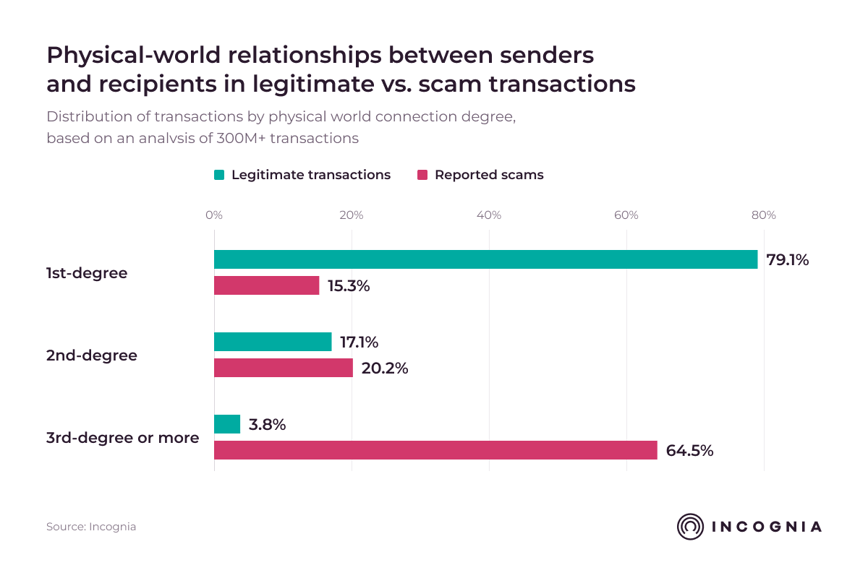
In an analysis of over 300 million transactions, nearly 80% of legitimate payments were between people with an observed physical-world relationship.
For banks, that connection can add confidence to a payment, even when the recipient is new. The bank may never have seen these accounts transact before, but their location histories can suggest that the people behind them already know each other.
In a separate analysis of a bank with 80M+ monthly active users, the Physical Social Graph alone identified up to 70% of scam transactions in the analyzed dataset. That result shows how much relationship evidence can contribute to detecting scams, including when the sender’s device and approval look legitimate.
How the Physical Social Graph helps banks assess scam risk
A customer gets a call from someone impersonating their bank. The caller tells them to transfer money to a “safe account.” The customer uses their usual phone and approves the payment, so sender-side checks may look reassuring.
If the available history shows no observed connection to the recipient and the customer is on an active call during the transfer, the bank has more reasons to look closely. Signs of mule account activity on the recipient side can further heighten the risk.
No observed relationship alone doesn't automatically make a payment a scam. The bank needs to assess what that finding means alongside the device, recipient, and payment information.
That’s why our Real-Time Scam Prevention solution combines the graph with additional signals, such as active call detection, remote access tools, mule account detection, and more.
A phone being controlled remotely or a recipient linked to suspected mule activity gives the bank more reasons to question a payment. Active calls and device tampering can also contribute to the assessment.
A fuller picture of the payment
A customer’s identity and approval can look right even when they’re being scammed.
The Physical Social Graph adds a different piece of information: evidence of a connection to the person receiving the money, built from activity over time.
Together with device and recipient signals, that gives the bank more to go on before the money moves. Fraud teams can use the combined assessment alongside their own checks to decide when to let a payment through, warn the customer, or stop it.