Fraud prevention is supposed to protect your users. But a lot of the time, it's punishing them instead.
A user upgrades their phone and gets locked out of their account because the device isn’t recognized.
A new customer gets flagged during onboarding because of a minor data mismatch.
A legitimate payment gets blocked because it was wrongfully flagged as suspicious.
These are all friction problems caused by fraud controls. The tighter the controls, the more your good users deal with this.
But it doesn't have to be this way. You just need to be able to verify identity without asking the user to do anything.
That might sound difficult. But it's not.
Location intelligence is the best way to verify identity in the background, which means fewer false positives and less friction for your good users.
But isn’t location easy to spoof?
Yes… if you're relying on traditional location signals.
I covered this in the last edition, but the short version:
Most institutions rely on OS-level geolocation like GPS or IP. But GPS can't pinpoint where you are within a building. An IP address is only precise enough to determine what state you're in. And both are easy to spoof.
Precise location intelligence is fundamentally different.
It works by combining multiple signals together: Wi-Fi, Bluetooth, cell tower information, compass, accelerometer, gyroscope.
That combination makes it much harder to spoof and much more granular than anything that relies on GPS or IP alone.
It's granular enough to differentiate between two users in separate apartments within a building, down to 9-foot accuracy.
But, precision alone isn't enough.
The way to use this is by analyzing the full picture of a user's physical behavior over time, not single-point snapshots. Each person has a specific pattern. Where they live, where they work, where they go. That pattern is unique and very difficult to replicate.
That's what makes it possible to verify identity in the background for good users and flag accurately when behavior deviates.
From there, friction and false positives start to drop.
I’ll share a few examples.
Onboard new customers without the friction
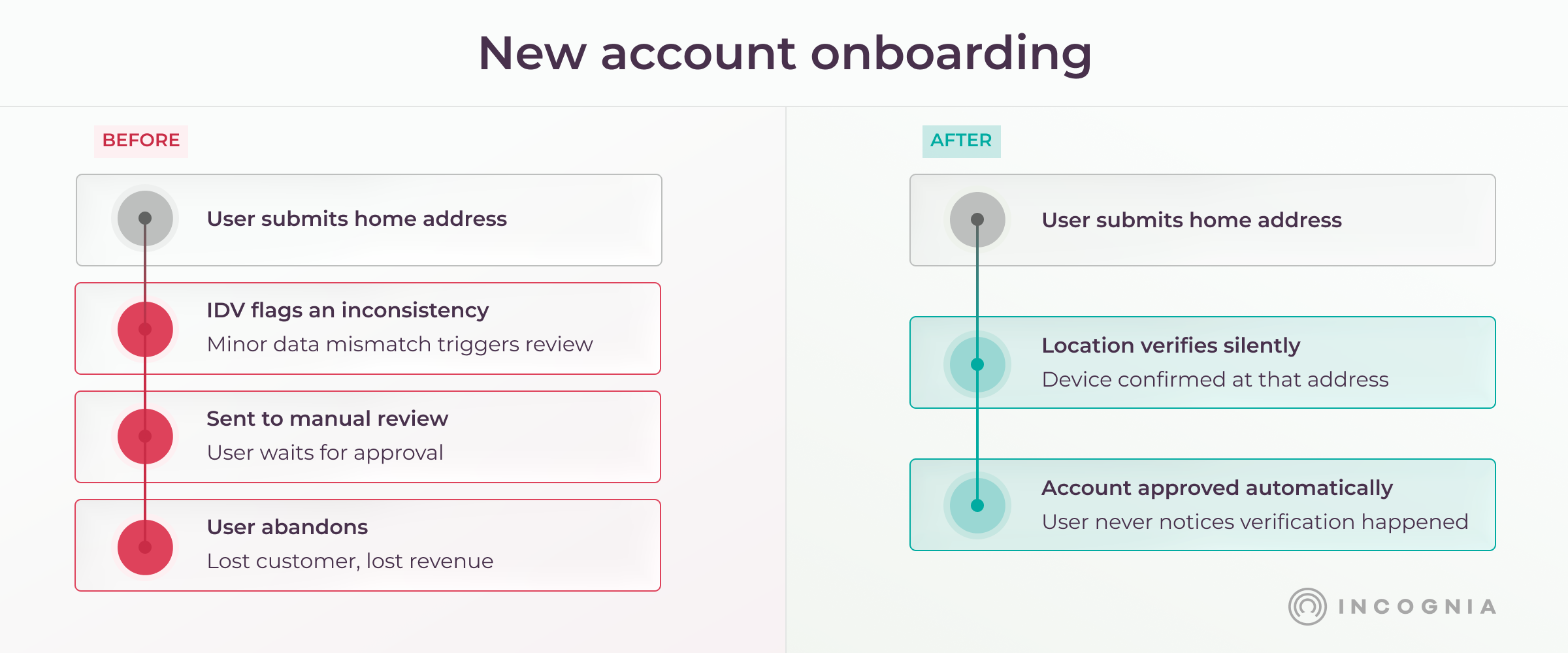
When someone opens a new account, they usually provide their home address and go through identity verification.
If something in their verification looks off (a typo, a name mismatch, etc.), the system typically flags it.
Then the account goes to manual review. The user waits. A lot of them leave.
With precise location, you can skip most of that. Instead of sending the user to manual review, you silently check whether the device is actually at the address they provided.
Our data shows that 85% of new accounts are opened when the user is physically at their home address. So for the vast majority of signups, location alone can verify the user without adding any friction.
That means fewer false positives from minor data inconsistencies and less friction at the exact moment you're trying to convert a new customer.
We saw this with Webull Brazil:
Their onboarding process was slowing down legitimate approvals and frustrating customers. Manual review bottlenecks were building up.
After deploying address verification with precise location, automatic approvals reached 92.5%, and manual review dropped from 19.2% to 2.5%.
Users didn't have to do anything differently.
Consistently recognize your users, even on a new device
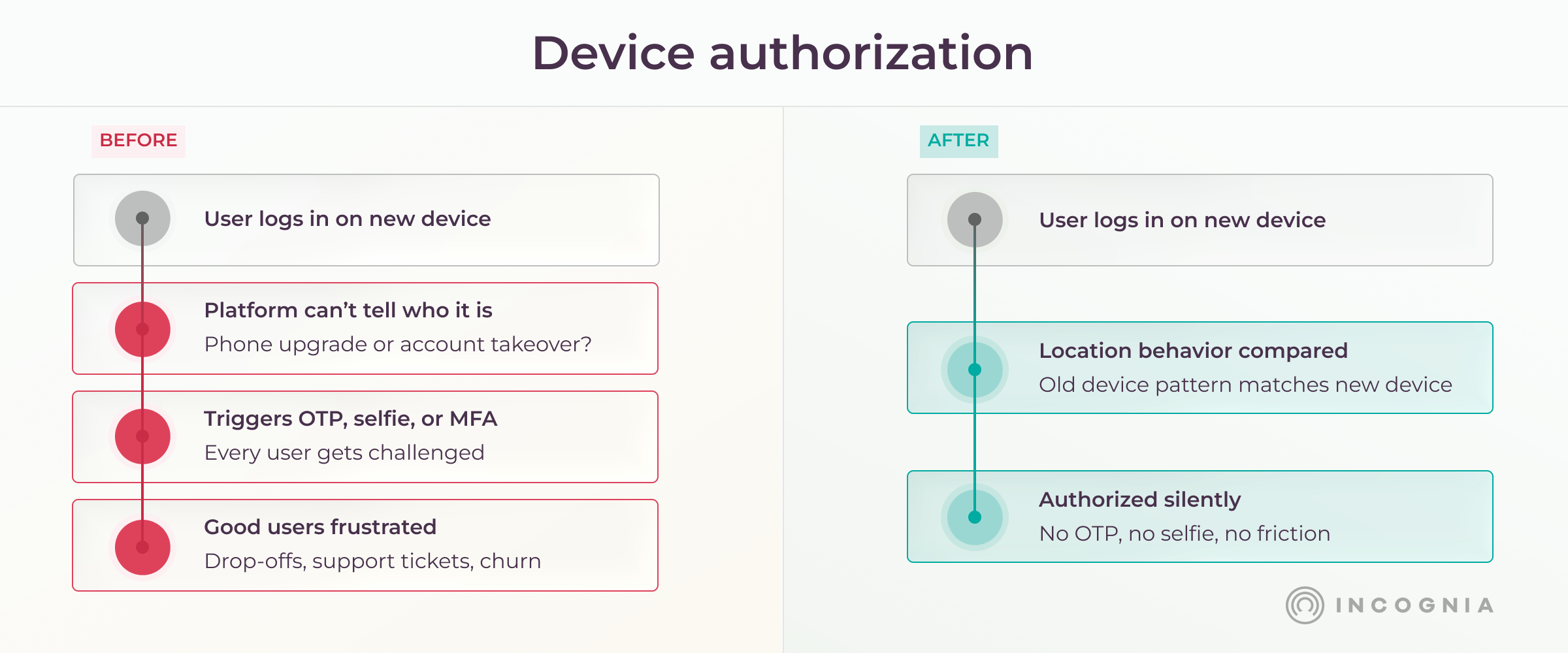
When a user logs in from a new device, some platforms can't tell the difference between someone upgrading their phone and someone taking over their account.
One response is to challenge everyone on a new device. OTPs, facial recognition, step-up auth.
Sure, that can catch bad actors, but it also adds friction for every legitimate user who just got a new phone.
Not to mention that these methods are getting easier to beat. AI deepfakes are defeating facial recognition. OTPs are notoriously vulnerable.
But with precise location, you can compare the historical location behavior of the old device to the new one. If the behavior matches, it's the same person. You can authorize them silently.
Our data shows that 95% of first logins on a new device happen at a trusted location, like home or office. That's a strong foundation to work with.
It's the same outcome as facial recognition (matching a user to a device), but with better UX, lower cost, and no risk of deepfake spoofing.
We saw this with a neobank with 15 million users.
Their default approach to securing instant payments was straightforward: when in doubt, add friction. Suspicious activity triggered face scans, MFA, or step-up authentication.
After integrating precise location intelligence, they could see that the vast majority of payments were happening from trusted locations. Users' homes, offices, places that are part of their daily lives.
As a result, they were able to classify 92% of transactions as low-risk and frictionless by default.
Unnecessary biometric and OTP step-ups dropped drastically, and fraud losses went down too.
Better location data, better UX
When you can verify identity silently and accurately, everything gets easier. False positives go down. Friction goes down. Your good users move through without ever being interrupted.
Precise location intelligence is what makes this possible. It's passive, it's continuous, and it's unique to each person. That's a hard combination to beat.
If your fraud prevention stack is creating friction for good users, reply and tell me about it. I want to hear what you're dealing with.